
It's time to stop talking about talking
Wisdom from the graduate students of SNAP at the AAAS Meeting

In its 178-year history, no one can remember a plenary panel at an AAAS meeting that was just graduate students. It was long overdue, and that was even more apparent after I had the privilege of moderating a group of graduate students at this year’s meeting.
The Scientist Network for Advancing Policy (SNAP) is a group of graduate students from around the country who have engaged in advancing science policy in addition to their research work. The students on the panel were: Miles Arnett, Erin Morrow, Alex Rich, John Patrick Flores, and Isako Di Tomassi (links are their LinkedIn profiles).
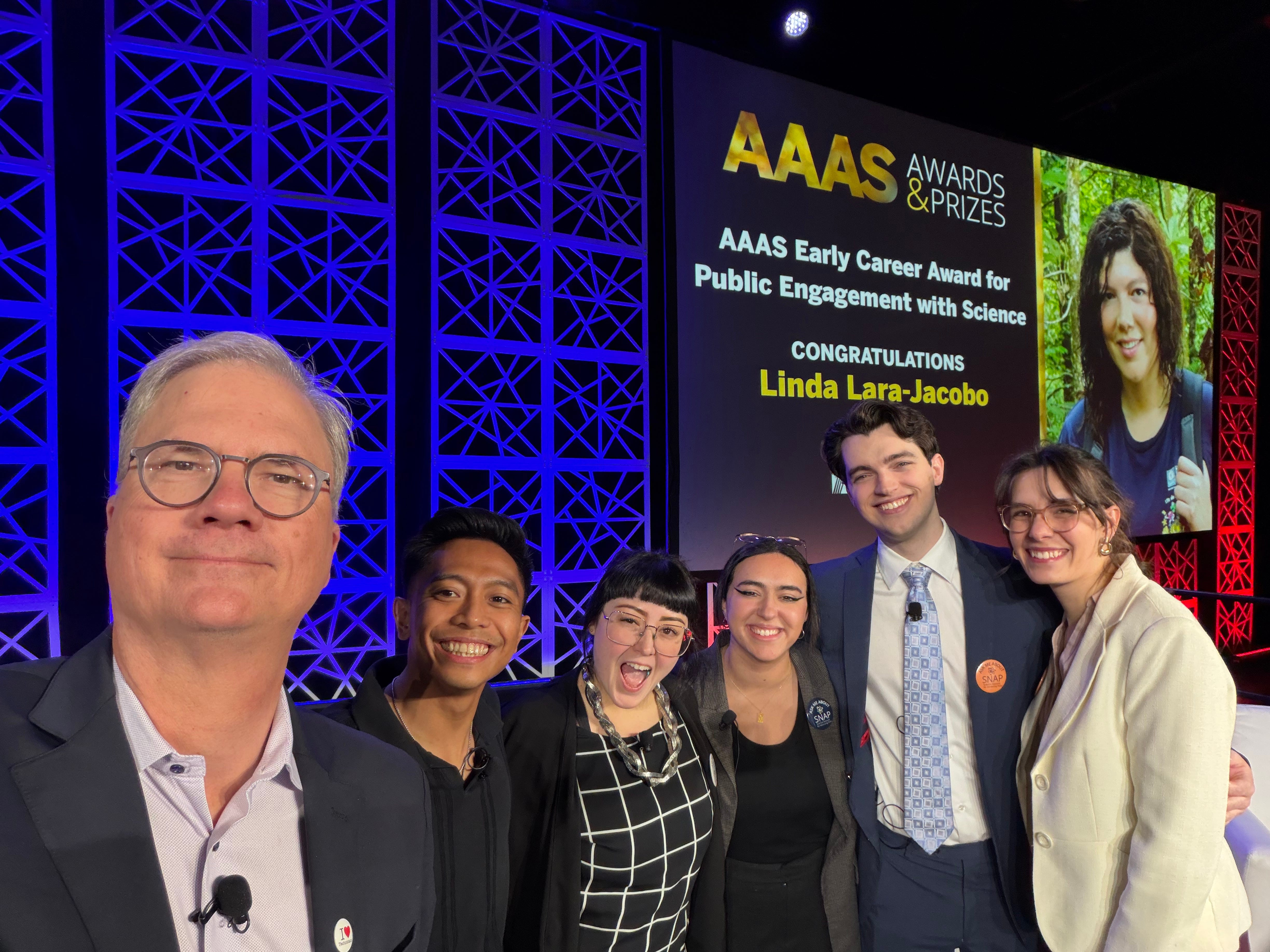
There was a lot of correct and tough medicine from the students for PIs, institutions, and scientific societies. The best summary was their characterization of the AAAS meeting as an echo chamber, and the related panels and speeches as “talk about talk.” SNAP is more focused on action and challenged everyone to think about what they were going to do on the Monday after the meeting rather than just nodding their heads in the panel and then going home and doing everything the same way.
I’ve written about a lot of things they brought up, like why PIs and institutions should give graduate students more freedom to pursue things outside of science that may better position them for careers outside of academia. Some of the most gut-wrenching moments I had as a provost were when graduate students came to my office to say that their PI had criticized them because they wanted to get out of academic science after graduating or to spend time in graduate school working on things like SNAP.
They also talked about the endless conversations in academia about the incentive structure. Institutions know how to put points on the scoreboard - grants, papers, awards, new buildings - and they’re basically built to optimize their ability to do that. PIs who don’t want their graduate students doing things like SNAP are responding to this incentive (which they should resist!). My column about this was called “Groundhog Day,” but “talk about talk” is even better.
Alex Rich also talked about the absurdity of college presidents navigating the current crisis in science without better communicating with their campuses. She sharply said, “you can’t defend the house by pretending it’s not on fire.” I’m probably more sympathetic to the presidents who need to play it carefully to protect their budgets, but I’ve also advocated for more direct communication with the campus at the same time. (Here is my piece from April where I tried to wrestle with how this could be done.)
These messages are far more compelling coming directly from the SNAP crowd rather than an old guy like me who just engages in talk about talk, so the best thing to do is watch the whole video below. A strong group of other SNAP members was in the audience to support their colleagues, so there is a lot of cheering and clapping during our panel. Below that is a summary from NotebookLM that I heavily edited.
Pretty good edited AI summary of video (but you should watch the whole thing!)
Miles Arnett, a PhD candidate at Penn and president of the Penn Science Policy and Diplomacy Group, described the SNAP’s mission as a dual-pronged effort to “mobilize for large-scale initiatives” and, perhaps more pivotally, to “reconnect scientists to the communities they came from and the ones they serve”. This focus on connection was a reaction to the perceived isolation of the modern researcher.
The first major spark for SNAP was the “McClintock letters” project, an op-ed campaign led by Izzy Di Tomassi and Emma Scales. After Damasi’s own advisor, a federal scientist, was fired, she observed local social media comments questioning the value of scientific work. The realization was stark: the public often has no idea what happens inside the research institutions located in their own backyards. SNAP’s response was a “lightning in a bottle” moment. They coordinated over 600 scientists to pledge to write op-eds for their hometown papers, focusing on their origin stories and why they care about their work. This resulted in over 200 published pieces across 45 states, effectively humanizing the face of science for local audiences.
The Dimming Light: Addressing the PhD Crisis
One of the most poignant moments of the plenary came from Alex Rich of Yale University, who addressed the psychological toll of modern graduate education. Rich described a “canonical” experience for PhD students: arriving with passion and brilliance, only to have that enthusiasm eroded by the systemic failures of academia. “You see over many years the light drain from a PhD student’s eyes,” Rich observed, noting that this decline is often treated as an “accepted part of the PhD”.
Rich argued that this “noise of academia”—ranging from authorship disputes and lack of mentorship to sexual harassment and the relentless pressure to publish—is “everything but the science”. When the focus shifts away from the actual research and toward navigating a broken institutional structure, the passion that drives discovery is lost. This loss is not just personal; it is a systemic failure that drives talented individuals away from the fields where they are needed most.
The Incentive Struggle: “Forgiveness, Not Permission”
A recurring theme throughout the session was the conflict between student advocacy and the traditional incentives of Principal Investigators (PIs). While some panelists, like Miles Arnett and JP Flores, praised their PIs for being supportive of their “non-lab” activities, they acknowledged that they were a “biased sample”. Many of their peers were “barred” from attending the conference or felt they had to hide their policy work to avoid being seen as “wasting time”.
Erin Morrow’s approach to this tension has become a mantra for many in the network: “I personally tend to abide by the rule ask for forgiveness not permission”. Morrow noted that even if a PI is not intentionally obstructive, they are not “incentivized” to support advocacy because the current academic system only rewards experiments and publications. Rich and Morrow argued that without a “broader change of those that incentive structure,” the cultural shift toward public engagement will remain a fringe activity rather than a core component of scientific identity.
To combat this, SNAP members are working on practical solutions like the “PI’s Guide to Science Policy”. This document aims to “legitimize” the field for senior faculty who may view policy as a distraction from “running PCRs”. The goal is to drive home the idea that understanding policy is “part of what it means to be a scientist”—a realization that must begin as early as the undergraduate years.
Defending a House on Fire
The panelists were equally unsparing in their critique of the institutions themselves. Alex Rich utilized a vivid metaphor to describe the current state of higher education: “We can’t defend [the house] by pretending it’s not on fire”. Rich argued that while universities are facing unprecedented attacks from outside actors, some of those attacks are rooted in “good faith” questions about the value and transparency of research. By ignoring the “alarms” raised by early career researchers regarding incentive structures and career preparation, institutions are neglecting the very people inside the “house”.
The critique extended to how institutions attempt to “talk” about these problems. Rich ridiculed the trend of “talk about talk series” regarding public trust in academia. She described the irony of “a bunch of academics sitting around academically talking about mistrust in academia” while the public is entirely absent from the conversation. JP Flores added that these discussions often become an “echo chamber,” where the same points are repeated without any “actionable thing” resulting from them. Flores challenged the audience to think about what they would actually do on Monday morning—whether they would change their behavior or simply share quotes from the conference.
A New Blueprint for Scientific Societies
The panelists also addressed the role of scientific societies like AAAS. While acknowledging the importance of leadership and “clarity” during times of crisis, they noted a disconnect between the “email inbox” of a society and the “community” of the lab. Miles Arnett pointed out that when a crisis is met with “silence” or statements that are “out of step with reality,” societies lose credibility with their members.
The solution proposed by SNAP is “co-design”. Rather than top-down initiatives, societies should tap into the energy of grassroots organizations to create “open access material” and build infrastructure together. JP Flores emphasized that the future of science is not just about the people in leadership positions who haven’t “touched a pipette” in 30 years, but about the students who are “going through it” right now. By giving a “seat at the table” to these younger voices, societies can ensure their missions align with the evolving needs of the workforce.
The Future: Unmuzzled and Action-Oriented
Looking ahead, SNAP is not slowing down. Their current initiatives include “Stance on Science,” a nationwide effort to ask candidates for public office specific questions about science policy from the perspective of early career researchers. They are also developing an open-access science policy course and hosting “hackathons” at various institutions to solve policy-related problems.
As the session drew to a close, JP Flores offered a final, stirring reminder to the plenary audience. He gestured to the rows of SNAP members in the room, stating that “the future of science is really in this room”. He invited the leadership of AAAS to the SNAP reception to speak with these students in a more “candid” and “unmuzzled” manner. The plenary session served as a public debut for a movement that seeks to redefine the scientist as a civic actor—one who is as comfortable in a legislator’s office or a local church as they are at a lab bench.
Thank you so much Holden for giving a platform for the voices of concerned graduate students, who are living so directly many of the failures of the current academic model. We need to do so much better as nourishing the next generation of scientists and regarding them as full human beings, then bringing the scientific work out into the public that such work was always meant to serve. I had an absolutely terrible graduate school experience marked by just about every one of the problems these students outlined here. When I and my peers spoke about it, we were threatened into silence. My hope is that empowering today's up-and-coming scientists to shape their own work and training experiences can help us all prevent any more of this abuse and waste of amazing scientific potential.
Do you agree with panelist Alan Rich’s point that the canonical experience for a doctoral student in the sciences is to experience “the light fad[ing] from their eyes”? What do you think causes that? Holden, how would grad students nurture that light and still get the experience and funding they need if they had more freedom? I guess I’m looking for more specifics. It sounds to me as though freedom to pursue rich learning experiences + demand of meeting lab expectations = soul crushing workload.