
Talking about AI at graduation without getting booed
My remarks at the UMBC commencement

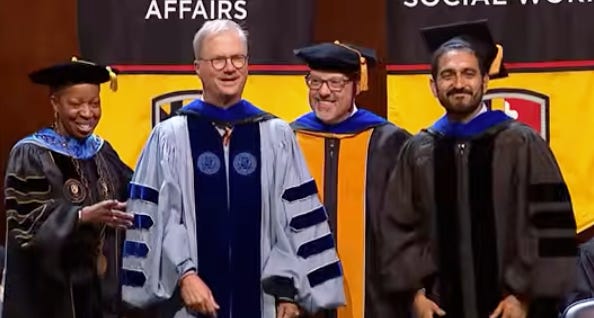
I had the honor of speaking at commencement at the University of Maryland Baltimore County today and getting an honorary degree.
Proud to be a Retriever!!
I wish everyone fussing about higher education right now could go to UMBC and see what they are doing. It’s a real university with real people. Lots of students of all different identities having their lives changed for an affordable price. Faculty who clearly care about their students. Staff excited to be there.
The president, Valerie Sheares Ashby, is someone I’ve known her whole career. I gave her the first job she had in administration and knew should would be a president one day. When I acknowledged her from the podium, the crowd cheered - not something many presidents get to enjoy any more. Getting a degree from her rather than the other way around was a thrill.
Someone needs to tell the New York Times and the Atlantic to stop covering Yale and Harvard and go see a real university like UMBC doing real stuff.
Graduation speakers have been getting booed this year talking about AI. I always interview students before writing these to find out some inside info and what they want me to talk about. They definitely wanted me to talk about AI - just not telling them they were doomed. I don’t believe they are. You can see what I said in the video or below. The sound was really great, so I got more reaction than usual.
Thanks to President Sheares Ashby and the awesome people of UMBC. I had a blast.
Here’s the video and remarks below. My part starts at 51 minutes in.
Hello, everybody!
UM!
[BC!]
UM!
[BC!]
Congratulations, Retrievers! Class of 2026!
You made it through a lot. Pandemic, divisive politics, international conflict.
And many of you started out in Susquehanna Hall. A dorm so bad that when they painted a stripe on the wall in the lobby it actually livened the place up.
You managed to take all the classes you needed. Some of them were hard, but the classes weren’t nearly as challenging as getting registered for them on myUMBC. Fortunately, you learned how to drop what you were doing just at the time your slot opened and push the button faster than your classmates.
You got to class despite encounters with the world’s largest squirrels and a guy who roams the campus with a snake around his neck.
But you felt safe, because Spider-Man was always nearby thanks to someone named Ronan.
And you needed him, because there weren’t lot of ways to escape. When I asked someone who is graduating today where they went to drink and hang out, he said, “literally nowhere.”
That was good for the Uber drivers who took you to Federal Hill.
Despite the isolation and the quirky traditions, when you came to UMBC, you joined an amazing community that succeeds together where you were taught how to learn and how to work in teams by professors like Joseph Washington and Tiffany Gierasch. They got you through hard material not by bombarding you with more information, but by helping you realize that you could learn it.
And you went to school with students with similar interests to you.
You wore your nerdy label with pride.
When I went to college at a university full of frat boys and sports fanatics, people made fun of the fact that I was the first person to solve the Rubik’s Cube on national television.
If I’d come here, people would have made fun of how slow my time was.
Well, graduation speeches have three ideas in 12 minutes. So, I’d better get going.
Nobody’s Normal
I don’t think I can stand in front of this many students and not mention the fact that we are in a mental health crisis among young people. As many as 50% of college age students have sought mental health services. That’s a lot of people here today who are hurting. I can understand why anyone would be struggling given all that’s going on in the world – and especially with the stress of college and the political environment. Lots of pundits want to tell you why this is happening. Some say it’s your phones. Well, a recent study in the National Bureau of Economic Research showed that taking phones out of schools for three years had no detectable effect on test scores and very small effects on measures of student well-being. I’m pretty sure the problem is not the phones but an outdated and biased idea of what it means to be ‘normal’ that most of us can’t conform to.
You may notice that my hand movements, the lack of modulation in my vocal tone, and the fact that I can’t stop swaying back and forth are a little unusual. That’s because I’m autistic. Lots of famous and successful people have had this diagnosis. But far more autistic people -- and those who had autism but were never diagnosed, and therefore never given the supports they needed -- were much less fortunate, sometimes requiring constant care and exhibiting much higher rates of anxiety and depression than the general population. And that’s partly because, particularly in some sectors of society, our awkward traits come with significant stigma.
As an autistic person, I have the greatest admiration for all of you who had to do team coding group projects in CMSC 447.
For me, that even would be worse than trying to find a parking place for a 10 am class.
Now one reason I’m telling you this is so you know that if you have mental health struggles of your own, you can still be the speaker at UMBC commencement one day. In fact, all of us up here in our robes with our fancy degrees may look completely together, but every one of us has had challenges just like you may be having. So as my GW colleague Richard Grinker says, remember that if you look closely enough, nobody’s normal.
Do the work
Now as we are sitting here, science in the United States is in a state of turmoil. Rapid cuts to science and engineering funding and employment are roiling the workforce, stranding many young people who had plans to participate in admirable federal programs that no longer exist. No one would blame anyone here for being anxious about this.
Other countries around the world are seizing on this opportunity by recruiting US scientists abroad. It was already the case that science is growing in Asia at faster rates than here. The technological leadership that the United States has achieved over the last 80 years has enabled all of the commercial and political success that the country has had and, ironically, has produced many of the very people who are now trying undo it all.
These technocrats think it is now OK to weaken American science because they believe intelligent machines are going to do science and engineering for us, apparently even curing all diseases. There’s a simple reason why that won’t work. Because even if the machines can do a lot, they can’t benefit people without interacting with, well, people. And because you went here, you know a lot about how people interact with machines and with each other.
A recent study has shown that when AI agents do research, they are even more prone to ethical lapses than humans. When much of the public is doubting science, that’s the last thing we need.
So good news: we still need humans to do research. I believe we always will.
Still, nobody my age can stand up here and tell you with certainty that this will all be OK or precisely how it will play out. Too much is changing for us to know that. But what we can say is that over the course of tumultuous times in the world, the people who did the most to get us to the next place were the ones who did the work even when forces were trying to stop them.
So if you want to engage in resistance, do what you want to do as a person to defend science, but don’t stop doing the work you came to UMBC to learn to do. Make engineering generative and humane. Make sure that when AI does science, it does science that appreciates the properties and fragility of nature. Make machines that actually help people, especially those who haven’t benefited from the analog world as much as some of us. Energize people around you, including people who think differently and have different opinions.
When in doubt, stop the doomscrolling and do the work.
Your grit is true
Right now across America, graduation speakers are telling students that what they need to succeed in the world is grit. In 2016, Penn psychology professor Angela Duckworth told the world in a bestselling book and TED talk that achievement was a result of a unique combination of passion and perseverance. Well, she was only 29 years late, because your mascot has been True Grit since 1987.
UMBC is the original place where grit translates to achievement. You didn’t need a professor from Penn to tell you that.
And you don’t just have grit, you have true grit. True grit is not an absolute measure. True grit knows your story. True grit knows what you have overcome to get where you are. True grit understands the arc of history and the barriers it has placed in your way.
So only you know if your grit is true. Don’t listen to the voices that say you have to achieve this or that to show you have grit. Your parents can’t tell you. There’s no one on Instagram or TikTok who knows. Even Mr. Beast doesn’t know.
Only you know when your grit is true.
But I know this: you’ve got it or you wouldn’t be here.
You’re right on schedule
This may sound daunting, but we’re going a long way toward all these goals today because all of you are graduating!
Now some of the talk about changing the world that always shows up at graduations might make you uneasy. Some of you might not have your grand plan worked out. If that’s the case, you’re right on schedule. Most of you who do have a plan are going to change it multiple times.
So don’t worry if you don’t have it all figured out yet. And remember that whatever you do next, it’s the right thing if it’s what you want. Try to tune out what your parents and your advisers think you want. They don’t know everything that you know about what’s right.
They also didn’t get handed this divided world where everyone is obsessed with who belongs and who doesn’t. A world filled with uncertainty about politics, artificial intelligence, and the climate.
Tune it out and do what you think is right. You have the tools to decide and execute. You have the knowledge. You have the conscience. You just need to remember that when you leave here, you’re not going to have Spider-Man walking around to look after you.
You’ll have to deal with the Green Goblin and Doc Ock on your own.
The good news is you’re ready to take ‘em on.
And when you need to, you can come back to campus to be reminded of the things you learned and the people who changed your life.
And maybe Roll Fed one more time.
So that’s my talk.
Nobody is normal.
Do the work.
Your grit is true.
With these ideas, you’re ready for anything.
And remember, no matter what life throws at you, there’s one thing you can always cling to: you will never have to log onto myUMBC again!
UM!
[BC!]
Congratulations to the UMBC class of 2026!
Absolutely love this commencement address. Dr. Thorpe and had the privilege of seeing it live at my son‘s graduation. Listening to it again because it was awesome. Thank you for celebrating neurodiversity.