
Trying out ideas from my forthcoming autism book
My Burnett lecture at UNC

While I’ve started being invited to give talks about autism on various campuses and at conferences, I was especially excited to be asked to give the Burnett Seminar at UNC. The lecture was started by Juliet Davis who was the mother of longtime UNC trustee Tim Burnett. Tim and his wife, Janie, were amazing supporters of mine when I was in Chapel Hill. I never got a bad piece of advice from Tim, and he was always so unselfish with his time and wisdom.
The Burnett Seminars are affiliated with the UNC Learning Center, which provides services to students with learning disabilities and other challenges. Over the years, the talk has been given by some great leaders and thinkers about autism and ADHD. A few years ago, my Carolina connection Eric Garcia gave the talk about his terrific book, We’re Not Broken.
A lot of people from my past showed up. So, as I said at the beginning of the talk, I’ve given this talk in front of lots of people, but not as many that I’ve known since I was 9. It was emotional at times and interesting to see some people nodding their heads about me and others thinking that they’d never noticed me having these challenges.
The format was two 45-min lectures because it qualified for some sort of credit for some people. The first talk was what I have learned so far about autism and what the science says, both about autism itself and the disagreements in the autism community. I tried to make the case that there wasn’t as much disagreement as the discourse lets on — and that these disagreements are mostly counter-productive.
Here’s the video:
In the second part, I talked about my own experience and what I think we need to move forward as a community. In particular, how those of us who have autistic traits that may or may not rise to the level of a diagnosis can manage them — and how the world can help. I express this in this diagram where we have four challenges.
How can autistic people and their families figure out how far to push ourselves or our children to the right level of discomfort of social interactions that would make life more fulfilling?
How can autistic people manage our social challenges to make this easier while remaining true to ourselves?
How can the world adapt to make autistic traits less stigmatizing and more accepted (and therefore make the world better for everyone!)?
How can we turn down the temperature in the autism community so that we can work on these things rather than fighting about labels.
Here’s the slide I came up with for this:
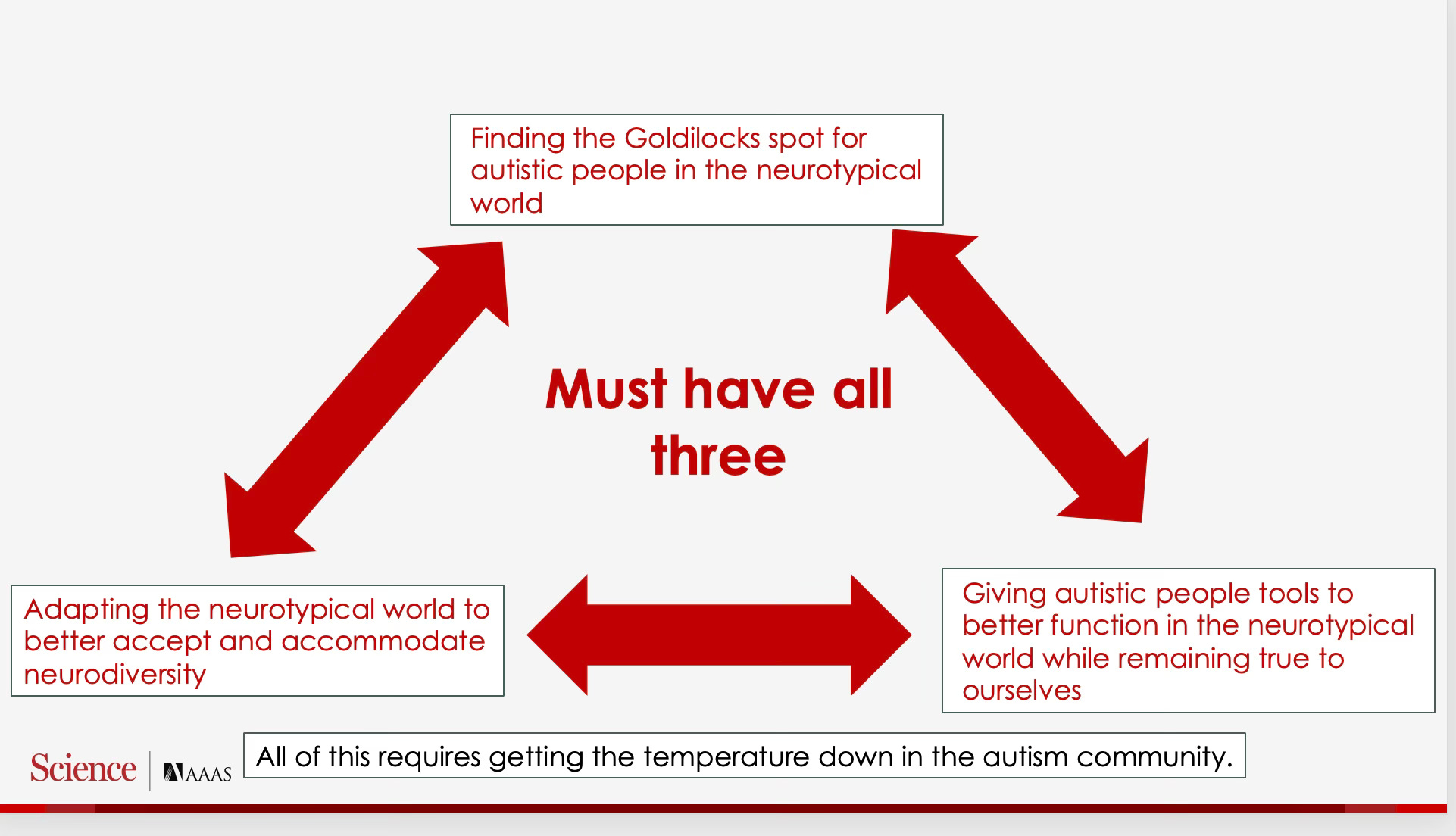
None of these things on the triangle can work by themselves. If all of the burden is on autistic people to figure out where they fit in and adapt, then that will just lead to more isolation — and to more people needing the support that comes with a diagnosis. If the burden is solely on the outside world to adapt, it will not lead to the fulfillment that comes with autistic people accomplishing things they didn’t expect to accomplish. So, all three points of the triangle work together.
And ironically, the arguing over what autism is and who is autistic is only going to cause more people to seek a diagnosis. Those who like to say that the mild end of the spectrum is somehow just imagining things or demanding too much are driving more people to get a diagnosis, not fewer.
It was an emotional and fulfilling day in Chapel Hill, and I was happy to be able to participate and put in a plug for the great work of the UNC Learning Center.
I really appreciate this post. My own journey has been filled with challenges that eventually led to my autism diagnosis at 25. During medical school, I went through some deeply difficult experiences that resulted in an autistic meltdown and ultimately pushed me to step away from that path. As I transitioned out of medicine, I began intensive behavioral therapy, and that process is what finally led to my diagnosis.
It was a painful period, but also an incredibly meaningful and defining one. Receiving that diagnosis helped me better understand myself, my identity, and the way I move through the world. I’m genuinely grateful for it—it allowed me to live more intentionally and to create a path that honors who I am.
Because of everything I went through, I feel a responsibility to make the road easier for others. I’ve since earned my Master of Public Health and am now working toward my MSW to become a licensed clinical social worker. My goal is to support autistic individuals and their families with the kind of specialized understanding I never had access to. Ultimately, I hope to combine my medical background and experience as a medical writer to advocate for the autism community in a meaningful way.