
The reverse alarm clock
Or how I learned to stop worrying and go back to sleep (at least more often)

Happy New Year. As everyone thinks about their new year’s resolutions, getting more sleep is probably at the top of many lists. We’re so obsessed with sleep since we’ve been learning more about how microglia reduce dementia by getting molecular junk out of our brains while we are asleep and a bunch of other things about how it helps you live longer. Maybe you got an Oura ring or an Apple Watch for Christmas and are resolved to do better with the help of technology.
I have no trouble falling asleep but as I’ve aged, I wake up at night and often can’t go back to sleep. And I have an autistic brain that loves details. So most gear for sleeping more makes it worse for me. I wake up and can’t wait to see what my gadget has to say about how I’m doing. Did I get an hour of deep sleep? (I did it enough times that I now know the answer is usually yes, so goodbye Oura ring.) I’m going to describe something much simpler that has helped me and maybe it will help you.
Bargaining with the sleep gods
If you’re above a certain age like I am, you wake up during the night, sometimes more than once. I remember being young when this didn’t happen. What a time that was. It was a long time ago. Then I went into a period where I woke up and then went back to sleep without any trouble. When that first digit of my age changed from a 5 to a 6, suddenly the interregna started getting longer and often I couldn’t go back to sleep. The worries of the next day and the things I had to do could outcompete my ability to go back to sleep.
If you google any semi-legit page about what to do about this, the first thing you will get is “don’t look at the time!”. Good advice. When you’re awake at 1:30, you’re bargaining with the gods of sleep about how “if I can just get a couple more hours, I’ll be OK.” Or, “what is wrong with me that I woke up so early?” If it’s 4:30, then you’re wondering about whether to go ahead and get up. Etc. Might as well start the coffee.
So, resolving to follow this advice, the next night you put a pillow on top of the alarm clock, but that doesn’t work either because many of us still want to know if it’s OK to get up when we wake up. The problem here is that a regular alarm clock is good at telling you when to wake up, but it’s really bad at telling you when to go back to sleep. For me, there’s a time when I’m OK getting up but which I would also love to sleep past. My sleep goal is 7 hours and I usually fall asleep around ten, so that time is 5 am. Sure, I’d love to sleep later, but if I make it to 5 am, I’m OK getting up, especially since I’m finishing a book. (If you’re 30 years old, I know this is hard to understand but just wait.) So, I don’t want to set the alarm at 5, but I might want to know when I wake up if it’s 5 am yet. Also, my wife is a much better sleeper and I try not to disturb her, so setting the regular alarm for 5 is out.
Enter the reverse alarm clock
Remember these?
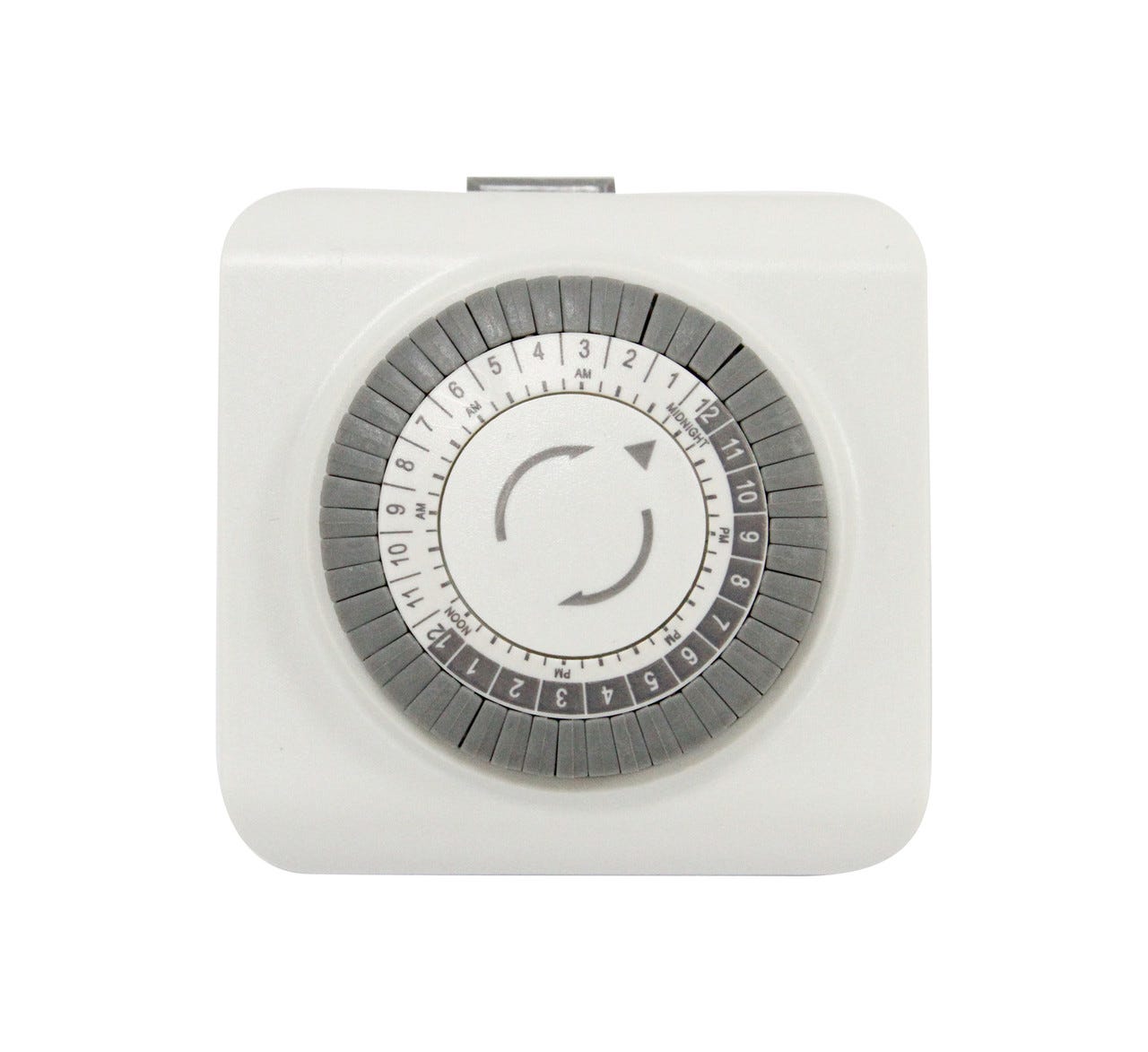
You might recall that before everything in our houses was connected to the internet, we used these analog devices to set a light in the living room to turn on and off to make it look like we were at home. You can still buy them cheaply online. The reverse alarm clock is one of these connected to something that dimly lights up. For me, it’s set at 5 am. And I use my Kindle, since it’s next to my bed, anyway, and has a pretty subtle power light. Plenty of other small lights will do the trick as long as they are not bright enough to wake you up.
If I wake up before 5, the light isn’t on. I can go back to sleep knowing it’s not a good time to get up while most of the time not thinking about what time it is and beginning to bargain with God. If the light is on, I can go back to sleep if I can and want to, but can also get up knowing I’m not in terrible shape. All of this happens usually without waking up my spouse. If I need to get up at a later time, I can set the regular alarm clock for that.
Since I started doing this, I’ve been going back to sleep more often. Your Oura ring has a lot more cool technology in it, but this may do you more good. If you wake up and can’t go back to sleep a lot, you might want to give it a try.
And if you’re young enough to sleep until your regular alarm clock goes off, enjoy it while it lasts.
Happy New Year.
Really appealing approach!
Plus, many ophthalmologists and institutions, including the American Academy of Ophthalmology and Dr. Joseph Allen, have shown that blue light significantly affects our sleep. Short sleep duration or waking up too early can be considered a mild form of insomnia.
Wishing you a wonderful day and a good night’s sleep!
Thanks! Your sleep issues appear very similar to mine, and I'm always looking for helpful advice.